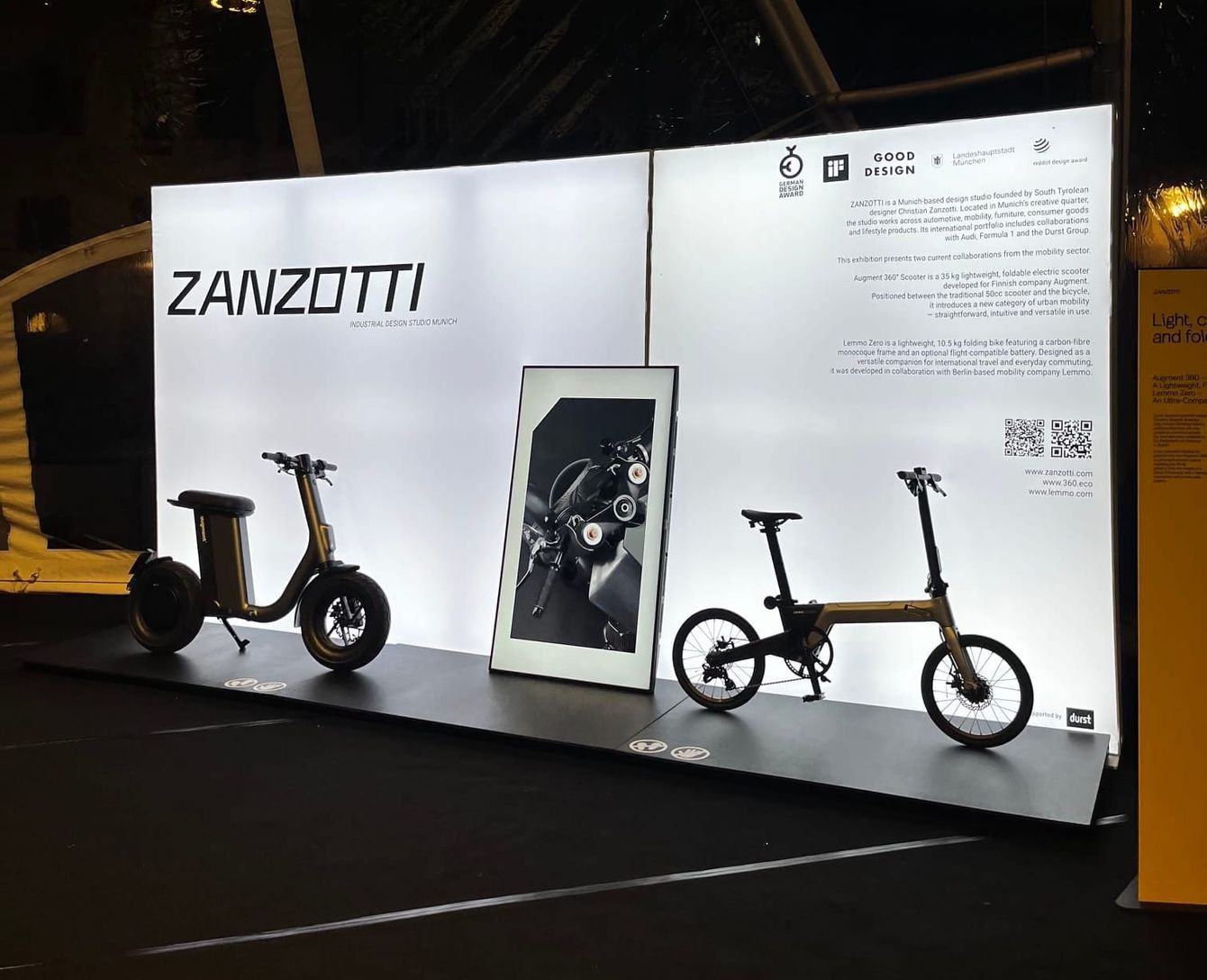
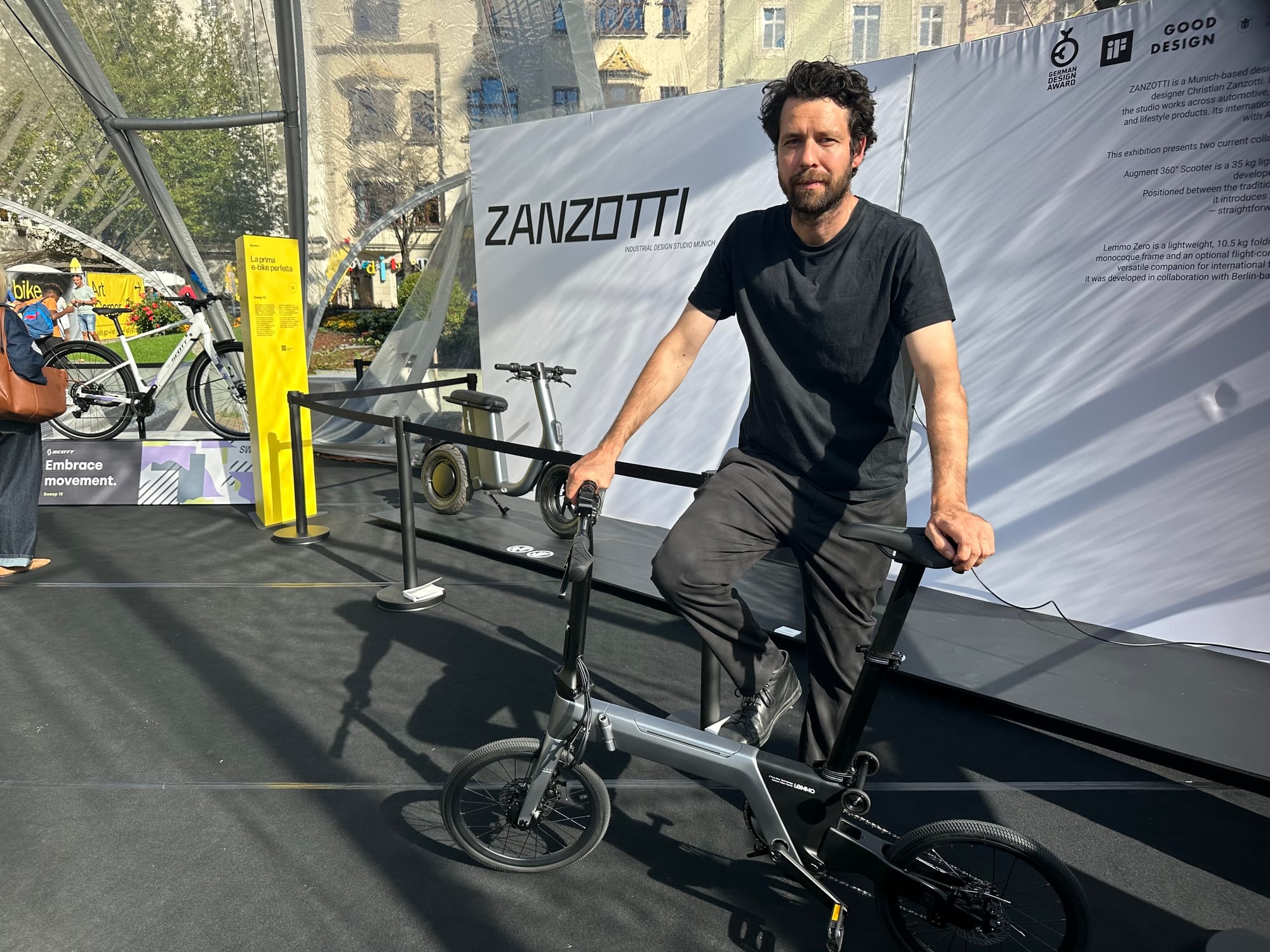
Bike Festa in Brixen, mid-September. In the Innovation Gallery, under a tent on the square, two vehicles stand on a black plinth in front of a backlit wall. A folding bike and an electric scooter. At night the wall is the brightest thing on the square.
The print and the backlit system are ours. The invitation was not. The city's marketing team approached Christian Zanzotti directly - they knew his work from earlier exhibitions and asked whether he would like to show something. He said yes, and only then did we hear about it. We offered to produce the wall.
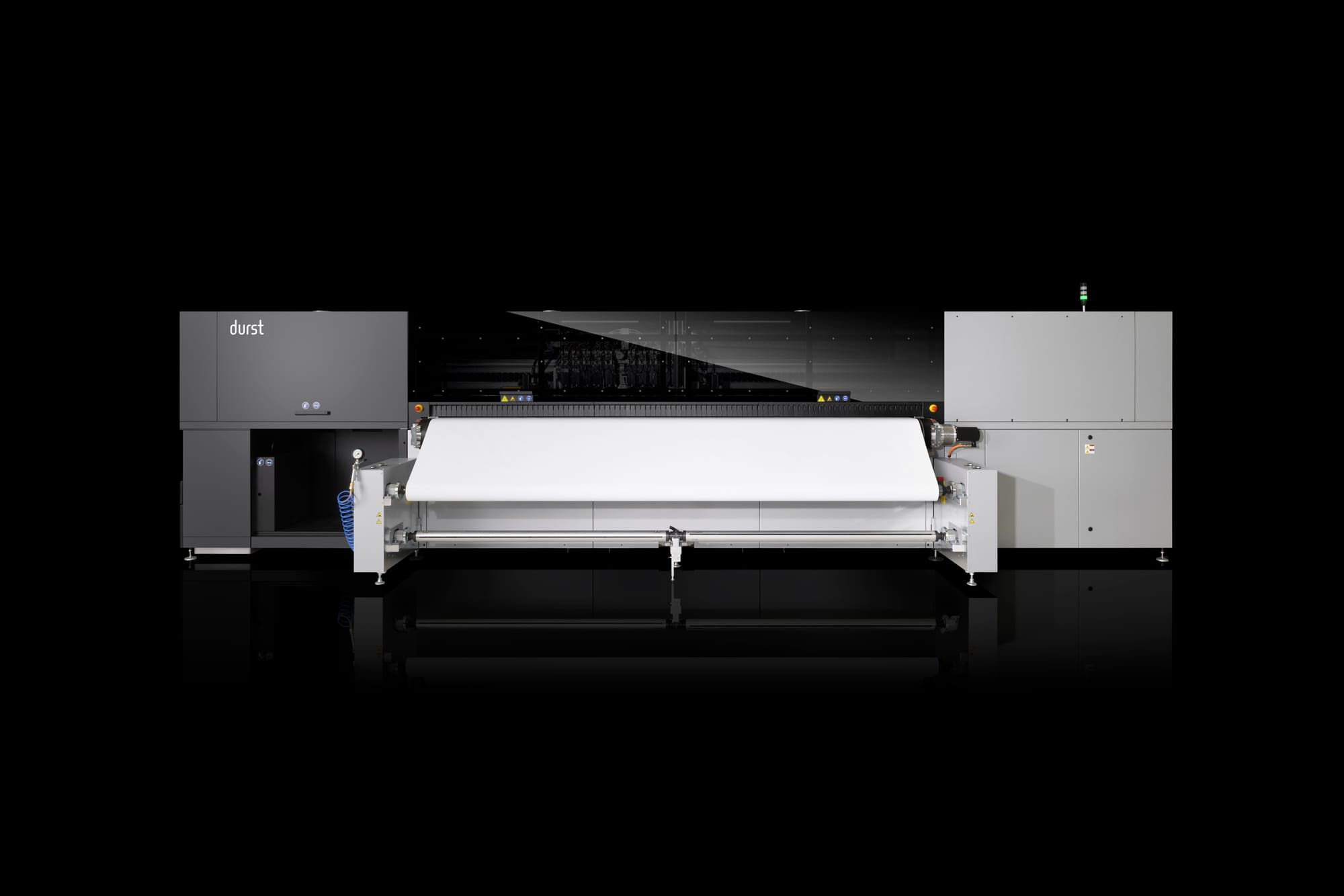
That order of events is worth keeping, because it says something about how this collaboration works. Christian introduced the design language of the P5 generation in 2018 and later carried it across to our label systems. He is not an in-house designer. He runs his own studio in Munich, and most of what he does has nothing to do with printing.
What is on the plinth
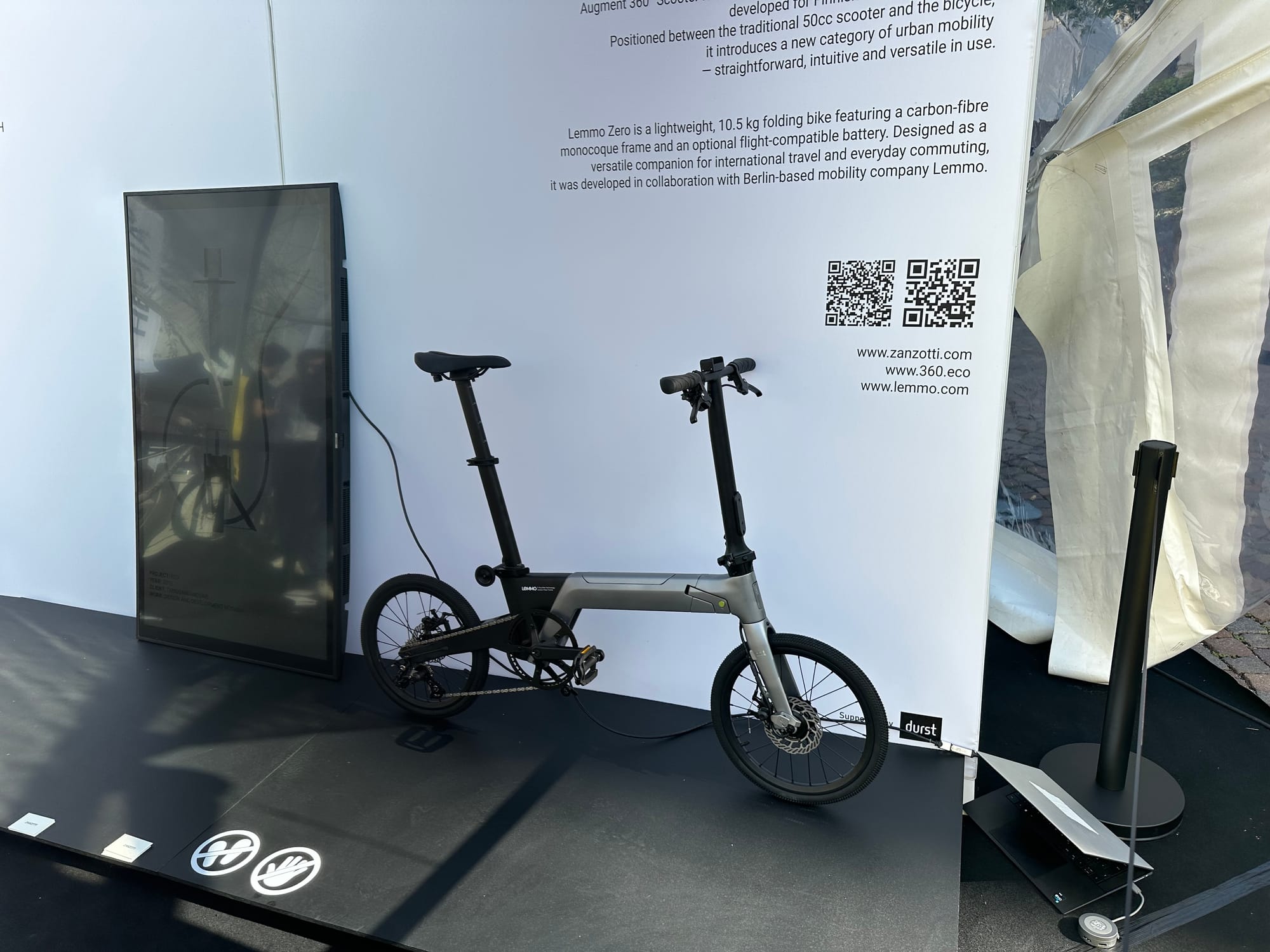
The bike is a Lemmo Zero, developed with Lemmo, a company based in Berlin and Shanghai. Ten and a half kilograms. A carbon-fibre monocoque frame, hollowed out as far as the structure allows. The rear wheel passes through the frame when folded; the hatch on top is not for the wheel but for stowing things. Folded, it fits into a suitcase. The battery is optional and clips on. Take it off and you ride an ordinary bike with no drag. The battery is sized to be flight-compatible.
Next to it, the Augment 360° scooter, built for a Finnish mobility company. It arrives at your door in a box. You open it, unfold it, and ride. At 35 kilograms it is, by Christian's account, the lightest in its class and the handlebars come off. Several customers keep it in their flat.
Two kinds of client
Christian's studio works with traditional manufacturers and with young technology companies at the same time, and he is clear that the gap between them is the point.
"A client like Lemmo is demanding, fast and very technical. Being in Shanghai gives them direct access to the newest technologies. And there is this hunger: we solve something, it was hard, and the answer is: good, what's next, can we push it again?"
Consumer mobility, he says, is a market you can still shape. You design for human behaviour, in large series, with industrial processes, and the product either works in that context or it doesn't.
Capital equipment is a different exercise. Longer cycles, far lower volumes, a great deal of manual work in every single machine.
"You move things in many small steps, and you have to celebrate those steps. You are also working on the mindset of the company: on the idea that something could be approached differently."
The operator is not the only user
The part that matters most for our machines came out almost in passing. Asked who he designs for, Christian's answer was that the operator is part of the target group, but not the whole of it.
In consumer work the end user is reasonably easy to define. In print production there is a chain: the operator at the machine, the company that bought it, and that company's own customer, whose job has to come out right. A design decision at the machine (where a panel opens, how far someone has to reach, what interrupts a movement) travels down that chain.
The P5 350 Core is a good example of what that means in practice. It is not a new platform but a further development of an existing series, and much of the design work sits in questions that only become visible when you watch someone work: where the operator stands, which movements repeat, what interrupts them.
That is the loop we get from the studio working elsewhere. Materials, ergonomics, how a person actually stands at a machine for eight hours: those questions come back from projects that have nothing to do with printing.
The uncomfortable question
We also asked something we had been curious about for a while. Walking trade shows around the world, it is hard not to notice how many machines now look like they belong to the same family as the P5. Did he know?
He did, but not at that scale.
"About a year after we first showed the P5, I saw one copy. I assumed that was it."
"We always assumed this would happen in China: that someone takes a template and copies it. By now it is everywhere. Europe, America."
Is imitation flattering?
"In a way, yes. Plagiarism is a topic where you have to keep different perspectives apart. There are cultures where imitating something well is considered a high art. Seen from that side it is a compliment. And I am generalising here, which is always dangerous."
"But for me, alarm bells ring the moment something moves towards resemblance. I will do anything to make sure the result has its own character and its own face."
Asked what protects against it, his answer was about method rather than law. His process starts by solving the problem from scratch, holding it open as long as possible before narrowing towards the best solution. Constraints appear on the way, such as what the market will accept and what can be manufactured, and the work is to find a distinct answer inside those constraints rather than borrowing one that already exists.
He ended the conversation with a line we have been thinking about since:
"So far we only know one side of being copied. Let's see where it goes."
Why this belongs here
Nothing in Brixen was a Durst project. A designer we work with was invited by his own city, we printed a wall, and the two objects on the plinth will never run a print job. But this blog is about how things get built, and a good deal of what ends up in our machines is shaped by what happens in a studio in Munich when it is working on something else entirely. That seemed worth a first post from the company side.