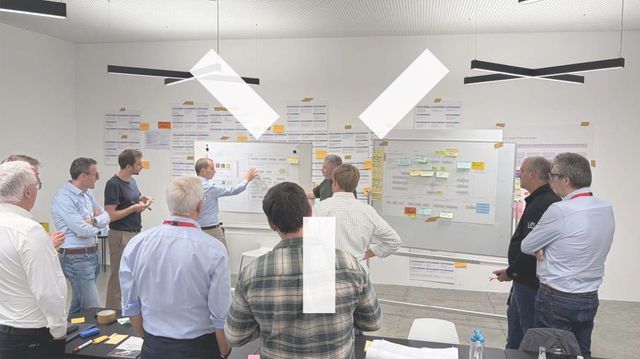

Some weeks you plan. This one planned me, truly. Long nights with the hackers over the weekend. And looking back, I enjoyed riding it.
On Thursday, 22 October, the RoboGym opened at Munich Airport. The next day our hackathon started, and it ran six days in a row. Six days of endorphins, ideas and prototypes. Then came Wednesday night. The hackers had gone home, the rush slowly wore off, and I sat in my Studio late at night, in front of a whiteboard full of arrows, with one question I couldn't put down. What of all this is true? And where is it really going?
Here is what I saw, and what I think. This is my view, and I am open to discussion.
The bang was heard.
At the opening, Bavaria's science minister Markus Blume put the week into one line: “The next industrial revolution will be decided where knowledge becomes reality.” Economy minister Hubert Aiwanger named the condition right after: “What matters is that the technology reaches our companies, including the Mittelstand and the trades.”
The facts first. The TUM RoboGym was built by Neura Robotics, one of Europe's biggest hopes in robotics, and the Technical University of Munich, on the LabCampus at Munich Airport. It has 2,300 square metres, 48 training cells and room for around 100 humanoid and service robots at the same time. The budget is over €17 million. Partners from more than ten industries, from automotive to care, have been testing real workflows there since September.
It's a gym, for robots. They don't lift weights. They lift boxes, fill bottles and load wooden parts, again and again, until it works. Humans show the moves in sensor suits or by teleoperation, simulation adds the rest, sim-to-real. Every repetition becomes training data for Physical AI.
Standing in that hall, one thing was clear to me: this is no longer just hype. Look closely, though, and you see where we are. These are still tests. Even the industry voices around the opening say it plainly: no universal humanoid can yet work a full shift. The bang was heard. The building has only just opened.
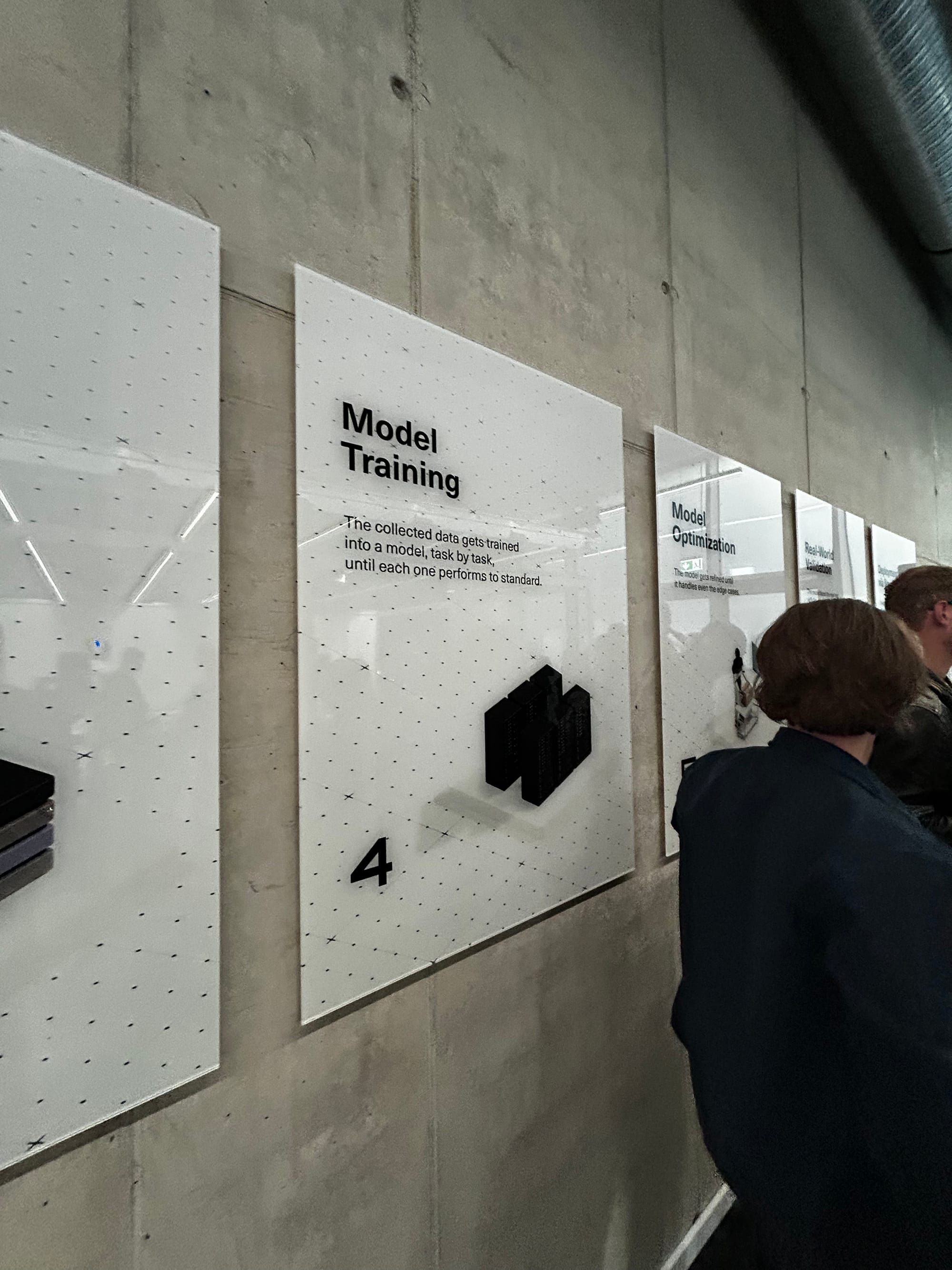
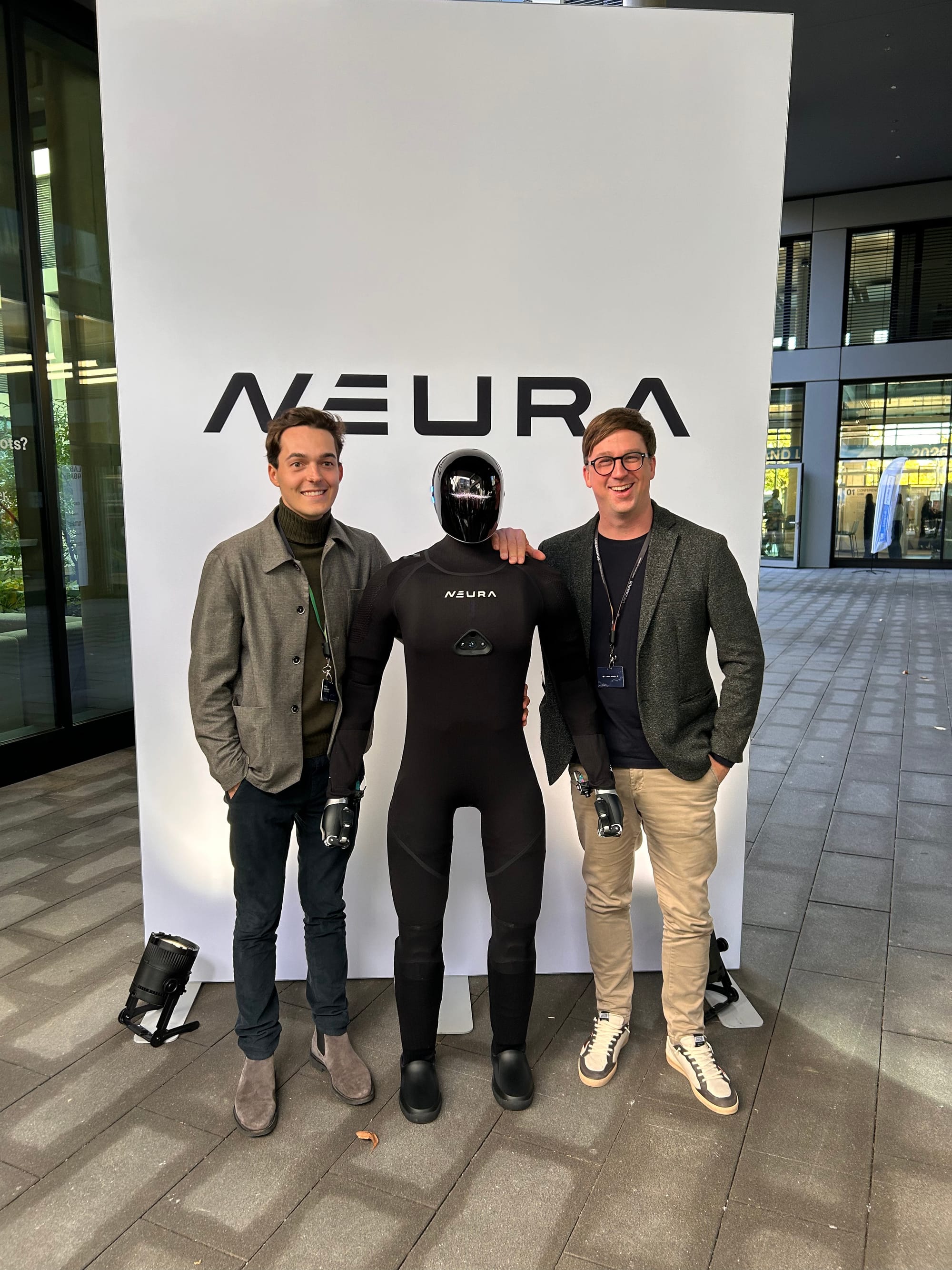
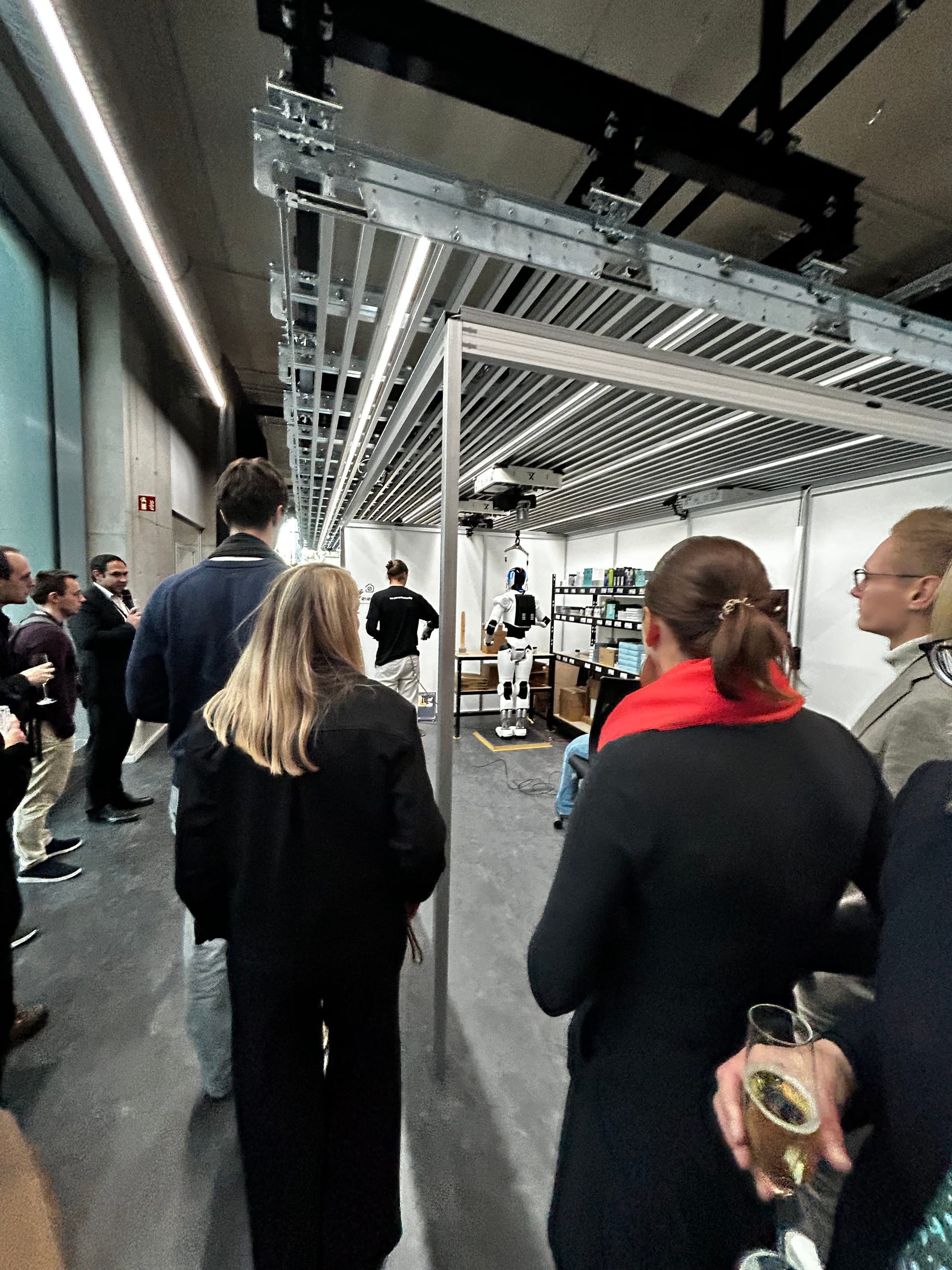
Opening day at the TUM RoboGym: from data to model, Neura’s new humanoid, and a training cell at work.
A wave far out at sea.
To me, Physical AI feels like a tsunami right now. Far out at sea you barely notice it. It is a long, flat swell, and it only rises where it meets the coast.
It hits the scalable coasts first, where the same task repeats a million times: logistics, and soon the household. From there it spreads into every corner, ours included. When will it reach our industry? I'm not sure. Somewhere between months and years.
The most impressive thing at the RoboGym wasn't a robot. Everyone filmed Neura's new humanoid, released that very day, me included. Still a bit bumpy, but have you ever watched a baby learn to walk? The real news was behind it. Neuron is one foundation model that runs on five different robot bodies. One brain, many bodies. What they learn is new.
Neura’s new humanoid walks the hall on opening day.
The money follows. In Q3 2026 alone, robotics start-ups worldwide raised $9.9 billion, more than double the same quarter a year earlier. Neura alone closed a round of up to $1.4 billion. Here in Munich, microagi reports a $100 million annual run rate after six months without building a single robot. Its product is data and training.
The idea behind it is recursive learning: every grip becomes data, and the data makes the next grip better. The billions flow into the learning layer. The hardware executes.
And print?
Of course my thoughts went straight to digital print. Where has scaled robotics in digital print been shown so far?
Nowhere. Not yet.
What exists today is a robot that loads and unloads boards at a flatbed or hybrid printer. A path taught once, a known material, a cell behind a fence. Several manufacturers offer this, mostly as dedicated projects and mostly on the fastest machines. Each of these cells works. None of them scales across an industry.
The market wants it. In a Keypoint Intelligence survey of 179 print companies in early 2026, nearly three quarters were seeking or considering a robotics solution. Fewer than 10% had one running. But a solution that scales across many plants, many jobs and several print machines? I haven't seen one. If you have, prove me wrong.
Wanted, but rarely running
Print companies asked about robotics in their production, early 2026
~75% are seeking or considering a robotics solution | <10% have already deployed one |
Source: Keypoint Intelligence, global survey, early 2026 · N = 179
Offset solved its version years ago with automatic plate changers, simultaneous washing and job changes that prepare themselves. That worked because the plate is a standard object, with the same format, punching and marks every time. Digital print has no such object. Its manual work sits in the material flow.
Logistics shows why robotics took off elsewhere first: the same box, the same move, a million times, often in buildings designed around the robot. A print plant grew over decades, machine by machine, vendor by vendor, and has to keep running while it changes.
Why not robots yet?
One day after the RoboGym, the robo.innovate hackathon started. Our track, Adaptive Industrial Vision, asked for a vision system that handles changing print materials on a running line. The toolbox: simulation, a VLM that describes what the camera sees, and conversational AI to talk to the cell.
Then the students came: brilliant people who don't know a single rule of print. Again and again, at the whiteboard and in the evening debriefs, they asked me the same thing. Why isn't all of this done with robots already?
To them the challenge looked solvable. And I had answers. Our industry lives on flexibility. It is high-mix production at its core: any material, any format, any run length, often on the same day and on the same machine. That flexibility is what makes print strong. It is also what makes it so hard for a robot.
Those were explanations, plenty of them, but not a clear answer in one sentence. That bothered me more than I expected.
Islands won't help us.
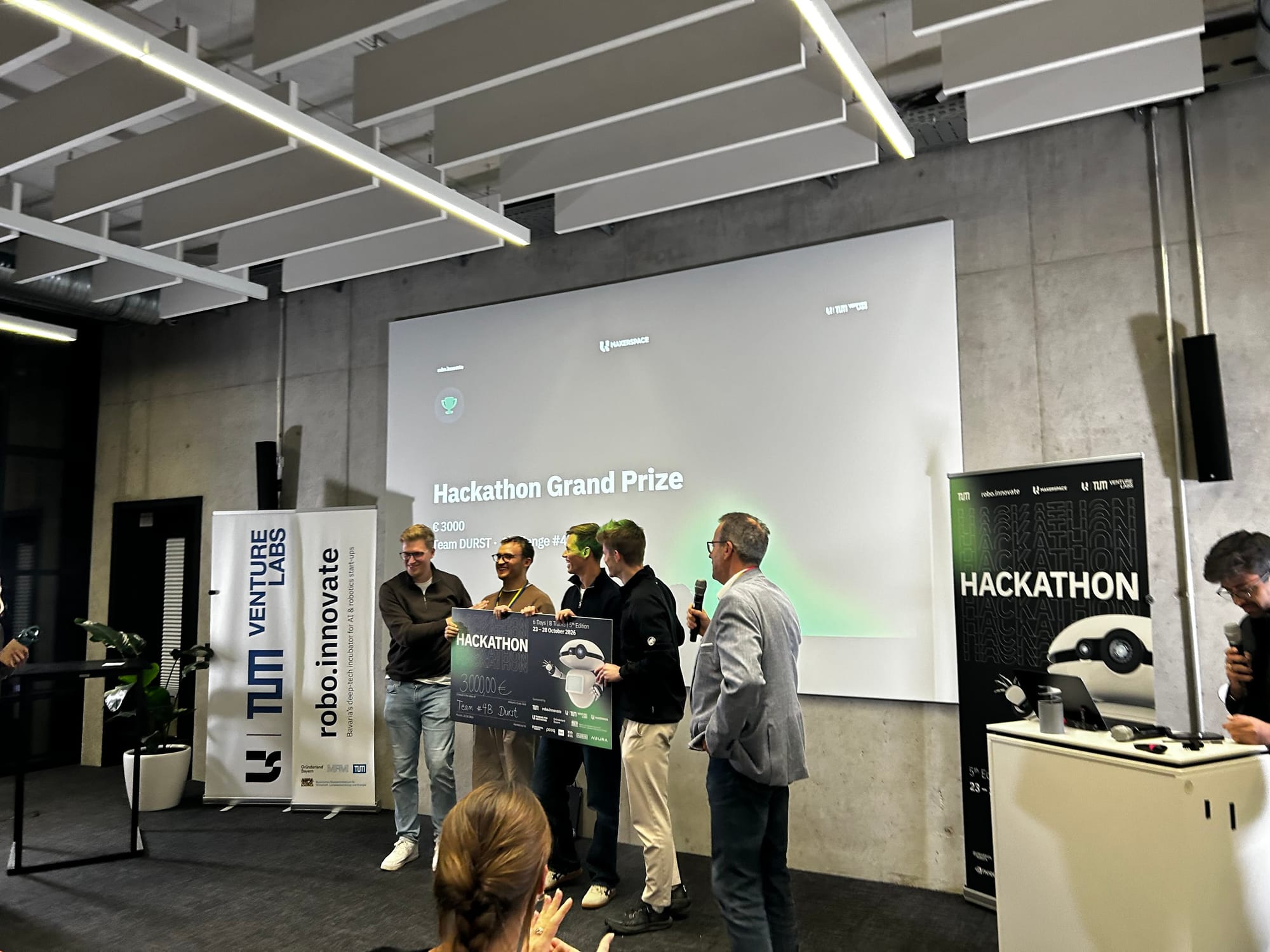
First, the speed has changed. In six days our Track 4 team built a working prototype with a new gripper concept, system-agnostic, so the brain runs on whichever arm is there. And it won the Grand Prize of the whole hackathon, ahead of the teams from all eight tracks. A hackathon prototype is not a product, and it was never meant to be one. What it shows is how fast good ideas move today. Market readiness is still a long road. But the pace is set, and robotics solutions will appear everywhere.
Second, that speed brings uncertainty. Who do you invest in? What becomes the standard, and what is gone by next spring?
Then a picture came into my head. Late one evening I drew the process on the whiteboard for the students: one job moving through a plant. Order, storage, print, cut, ship. At every step, a different robot system in the future, one per vendor, each with its own app, its own interface and its own service contract.
Picture a rush job coming in at 11:42. Today everybody stops. The printer pauses, someone swaps the roll by hand, the robot cell has to be re-taught, the cutter needs to know, logistics gets a call. Add a robot to every machine and that moment doesn't get easier. The operator just runs from island to island, from app to app.
We will all say: great, we have robotics now. In practice, running the plant will get harder, not easier. Five islands means ten handovers, and nobody owns them.
Every robot works. The factory doesn't.
Islands won't help us, not even a little. Each one automates a step and leaves the rest untouched. That was the sentence I had been looking for all week: in print, the problem was never a single step. It is the flow between them.
One tower.
Think of Munich Airport. Airbus and Boeing aircraft land there, flown by Lufthansa and Ryanair: different makers, different airlines, different interests. And there is one tower. The tower doesn't fly a single plane, but it sees all of them and decides who goes when.
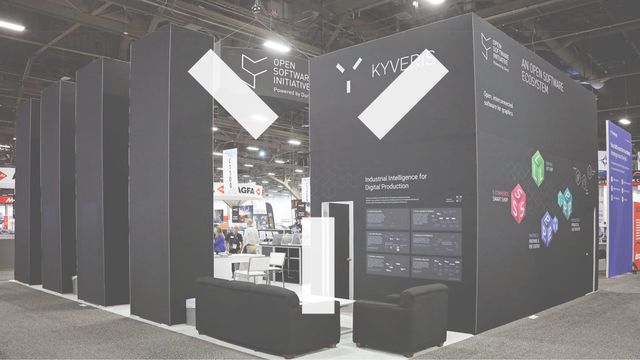
That is what our industry needs. And it is the ambition behind Kyveris: Industrial Intelligence as the layer that, step by step, orchestrates production across machines, robots and vendors. We are building it with our customers, one connection at a time. Without that layer, robotics brings innovation into our industry, but the gears don't mesh.
By the way, that is why this blog is called Ground Control.
The best of all worlds.
So after one week, what is reality?
The change is real. The bang was heard, and it won't go quiet again.
And print won't get its moment from a better arm. It gets it when the steps start talking to each other.
Where is it really going? Somewhere good, I believe. These were long nights, full of people who build first and ask later. Problems we carried for years suddenly looked solvable in days. I left with more clarity than I came with.
We live in the best of all worlds, if we get it right now: connected, open, with the process at the centre.
Next week I'll be at INKISH.FLOW in Bad Hersfeld for a keynote, to see how the print industry itself thinks about this. Islands or flow? I'm curious.
Which island in your production would you connect first?