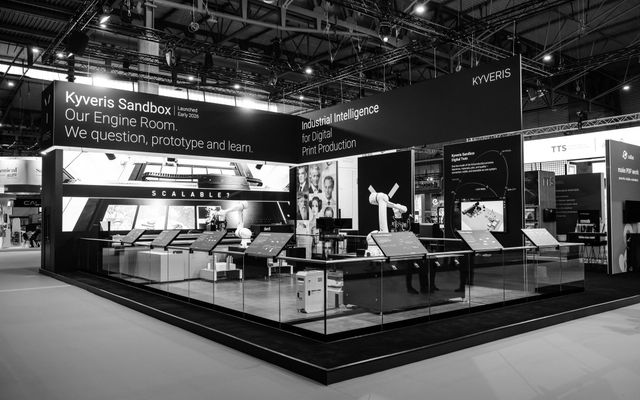

At FESPA in Barcelona in May, we showed the Kyveris Sandbox: real machines, real software, real robotics, all connected and running. The message was deliberately narrow – the direction is right, and here is the first evidence for it.
What works well in moments like that is the signal. What doesn't become visible is the work in between. Between one trade show and the next lie months in which conversations with production companies are held, prototypes are built and discarded again, assumptions are confirmed or refuted. That is exactly what will take place here from now on.
Kyveris is not a product
This is the first sentence that applies internally as much as externally. Kyveris is not software you can buy, and it will not become that in this form. It is a system architecture – files, machines, software, data and AI in an environment that keeps learning. Durst products are the reference implementation, and through the Open Software Initiative, partners and third-party systems join in.
An architecture does not come into being on a fixed date. It emerges step by step, and some of those steps go in the wrong direction. A blog that only showed finished results would paint a false picture of this development. That is why we also show what does not work yet.
We start with the problems, not the features
Our beta programme has been running since the beginning of the year. We talk to production companies about how they work – not about what they should buy from us, but about what costs them money every day and why nobody can put a precise figure on it.
One observation from these conversations shapes this blog more than any other:
Nobody asked for a dashboard. Everyone describes functions that do something.
A system that recognises that an order for a particular customer needs an additional check. One that says what a rush order pushed into the schedule does to the remaining delivery dates. One that knows which material can be used when the planned one is not available.
Visibility is consistently named as a prerequisite. Never as a goal. That is an uncomfortable finding for an industry that is currently talking a great deal about data transparency, and it will come up again in several posts here.
What readers can expect
Four kinds of posts, roughly weekly:
- Problems from production. What actually happens on the shop floor and why the obvious solution is usually not enough. The findings come from the beta programme and are reported anonymously.
- From the build. What we are working on right now, how mature it is and what we don't know yet. Some of it will become a product. Some of it won't.
- Ecosystem and partners. The Open Software Initiative, the collaboration with TUM Venture Labs in robotics, integrations with third-party systems. Kyveris works open or not at all.
- From the field. Trade shows, events, conversations. Less about what we showed there, more about what we were asked.
Where we really stand
Honesty includes a sense of proportion. Between three stages lie large distances, and it helps to name them.
1. Production is visible
You can see what is happening. Which job is on which machine, where material is missing, where the queue is building. This is where most companies in our beta programme stand today – and, honestly, so do we.
2. The system gives a hint
It tells you that something needs attention and why. A hint lowers the level of expertise required, but whoever receives it still has to be able to judge what to do.
3. The system corrects
It acts within limits you have set, and tells you afterwards. Only here does something change fundamentally. Nobody we talk to is there yet. That is not a contradiction of our ambition – it is the starting point.
Come along
This blog is not a channel for announcements. It is a working journal. If you work in production and don't share one of our observations, write to us. If you are a software company and want to know what an integration via OSI looks like, get in touch. And if we present something too optimistically, tell us.
The next stop is Printing United in Las Vegas, 23 to 25 September. Afterwards, we will report here on what we were asked there.